All postsLONG-FORM5 min read
How I Make AI Explainer Videos for About a Dime (Full Pipeline)
The whole machine behind my YouTube Shorts, station by station: idea, research, a fresh AI fact-checker, the hook score, the voice, scenes as web pages, sync, a 3D camera, loudness, checks, phone approval, scheduling, and the real cost.
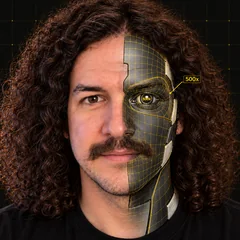
My laptop makes four YouTube Shorts a day, and the voice for each one uses about a dime's worth of credits. This post walks through the whole pipeline, one station at a time, using one Short as the example: "How an AI picks its next word." I made that Short by hand in a chat with Claude, outside the production line, using mostly the same steps. The station-by-station visuals in the video were rebuilt for it.
The machine at a glance
Picture a conveyor belt with twelve stations: idea, research, fact-check, script, voice, scenes, sync, 3D camera, sound, checks, approval and schedule. A blank page goes in at one end and a finished Short comes out the other. Most stations are AI or plain code. One of them is me.
1. The idea
Ideas arrive two ways. I send a link to my Telegram bot and it waits in a queue, or, when the queue is empty, the AI picks a fresh AI news story by itself. For an explainer there is one simple test I teach in the course: if you can sketch the idea on a napkin in three panels, you can animate it. For our example: your sentence becomes tokens, every possible next token gets odds, and the model picks one with a weighted dice roll.
2. Research and the fact-check
Claude Code, an AI that can type commands and write files on my laptop, does the research. Every claim gets a source in a claims file: the sentence I'll say, and the exact line that backs it up. Then a fresh AI that has never seen the work reads every source and gives the script a pass or a fail. It does fail things: one news script called an FBI account on X "Cyber Division", and the source says "FBI Cyber Branch". The checker gets up to three rounds. That Short still had problems after round three, so it was dropped and I got a message. Nothing gets voiced until the fact-check says pass.
3. The script and the hook
A production-line Short has about seventy spoken words, around thirty seconds of talking. The AI writes five hooks and scores each one from one to five on six questions: is it about you, are the stakes real, is there a question you want answered, is it fast, can you picture it, is it true. One of my early hooks, "This video was made by AI," scores 17 out of 30. A hook now needs 24 to ship.
4. The voice
ElevenLabs reads the script in a clone of my voice, one line at a time. A second AI listens back and writes down what it heard; a wrong word means that line gets voiced again. The voice also comes with the exact moment every word starts and ends, and everything after this hangs off that list.
5. Every scene is a web page
Every scene is HTML and CSS. HyperFrames, an open-source tool from HeyGen, opens the page in a hidden browser, freezes time, takes a picture, moves the clock one frame and takes another: thirty pictures a second for these Shorts. Because time is frozen, the same page always makes the same video, so every dice roll in a dice video is decided ahead of time.
6. Every move on a word
Every animation is pinned to a spoken word. The bars grow when I say "odds", because the code says setOdds(cue("odds"), ...). If the voice changes, the animation follows.
7. The 3D camera
Things farther away look smaller. Shrink things by their distance and a flat drawing becomes a world a camera can fly through, while the text stays sharp because it's still real text. The pinhole idea came from showhow by Sirio Berati (MIT, from tein). The whole trick is one line: screen = focal × x / z.
8. Sound and loudness
Small sounds land on events, from a palette where the same sound never plays twice in a row. Then the whole video is set to one loudness: -16 LUFS, with peaks under -2 dBTP and a soft start. My older videos were loudest in their very first second.
9. The robot checklist
Before I see a Short, a checklist runs: the right shape, under our one-minute limit, the loudness, a fact-check that says pass, and a hook frame bold enough to work as the cover. After the render it also scans for frozen frames. Anything that fails gets fixed before it moves on.
10. The cover and the approval
On the Shorts shelf the cover is often a frame from the video, so the hook has to read at the size of a postage stamp. Then the Short arrives on my phone in Telegram with Approve and Reject. Approve gives it the next free slot; Reject asks what should change and sends it back to be remade. If I don't answer within two hours, it approves itself (AUTO_APPROVE_MIN=120).
11. Scheduling and sharing
Four slots a day: 9, 12, 3 and 6, New York time. Claude, working in my Chrome browser, uploads the Short to YouTube Studio, marks it as AI-generated, and schedules it. Once it's public (a tiny oEmbed check asks YouTube first), a blog post, an X post and a daily roundup on Skool, Substack and Bluesky go out. Instagram and TikTok I post myself.
What it costs
| Item | Cost |
|---|---|
| Voice + listen-back check, per Short | 5 to 15¢ of ElevenLabs credits (about 9¢ on average across ten recent Shorts, measured on my account Oct 31 to Nov 2, 2026) |
| Rendering on my laptop | $0 extra |
| Checks, cover, Telegram bot, upload | $0 extra |
| ElevenLabs Creator plan | $22/month |
| Claude subscription | monthly plan |
If the $22 voice plan went to nothing but Shorts, at 120 a month, that's about 18¢ each. "About a dime" is the value of the voice credits one Short uses up from that plan. This post shows my process and promises no results.
Make your own
The full process is a course in the 500x Engineer Skool: Make Explainer Videos with Claude Code, in the paid Premium tier, with a starter kit that has a simpler version of this next-word project. Lesson 1 is free in Track Previews, and the free Set Up Your Computer course gets your computer ready first. You'll need a paid Claude plan for Claude Code.
Join the free community: 500xengineer.com/skool.
Daily email
Get each breakdown in your inbox.
One email each evening, right after the Short goes live: the AI tool it covers, the full write-up with sources, and how to get paid for it. Free, and you can unsubscribe anytime.
Sources
- ElevenLabs pricing (Creator, $22/month): https://elevenlabs.io/pricing
- HyperFrames by HeyGen (open source): https://github.com/heygen-com/hyperframes
- showhow by Sirio Berati (MIT): https://github.com/sirioberati/showhow
- The example Shorts: https://youtube.com/shorts/reL_vK-YbjM and https://youtube.com/shorts/n7kmGI8K34E
- Per-Short voice cost: my ElevenLabs account usage (TTS + speech-to-text credits per production-line run, Oct 31 to Nov 2, 2026).
Disclosure: the video's narration is an AI clone of my voice (ElevenLabs), and its short opening clip of me is an AI-generated avatar.