All postsSHORT4 min read
HeyGen Avatar 6: What HeyGen's 84% AI Clone Claim Means
HeyGen's own report explains its 84.4% score: raters picked Avatar 6 as real in 42.2% of the answers that picked a clip. The math, plan split and consent rule.
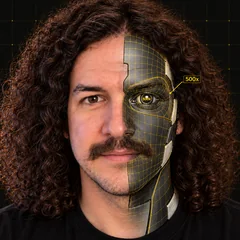
HeyGen says 84% of people can't tell its new AI clone from the real person. Its own report gives the raw result: 42.2% of the answers that picked a clip chose the avatar as real. HeyGen openly explains how it doubles that result into its score. Here's what the test measures, which model the plans include, and the consent step I'd build into any client offer.
What HeyGen released
HeyGen launched Avatar 6 on Nov 17, 2026, on its platform and API, according to TechBuzz Ireland's launch coverage. For an avatar of yourself, HeyGen's model page describes one photo and about 30 seconds of video.
The avatar gestures to match the script, including pointing and counting. HeyGen also says you can put two avatars in the same frame and write both sides of their conversation.
How HeyGen calculates the 84%
HeyGen's event page says 84% of people can't tell the avatar from the real person. Its research report describes a normalised indistinguishability score of 84.4%.
In the side-by-side test, raters picked Avatar 6 as the real recording in 42.2% of the answers that picked a clip (114 of 270 choices). They picked the actual recording in 57.8% of those choices. A separate 11.2% of all 304 side-by-side answers were "can't tell" (34 answers), excluded from those percentages.
Both clips used the same sentence over the same real audio, so this comparison doesn't test the cloned voice. The test used recordings of HeyGen employees and 20 external raters. The side-by-side test covered 76 people; the single-clip test covered 77.
HeyGen treats 50% as the point where raters can't tell them apart. It doubles the avatar's selection rate to express progress toward that point:
42.2% × 2 = 84.4%
That calculation is in the report. The score and the percentage of answers choosing the avatar measure different things.
These are all HeyGen's own test results:
| Test or measure | Avatar 6 | Real recording |
|---|---|---|
| Picked as real, same sentence and real audio, 270 answers that picked a clip | 42.2% | 57.8% |
| HeyGen's normalised indistinguishability score | 84.4% | Not applicable |
| Judged real when shown alone, Avatar 6 with the person's own voice | 65.1% | 78.9% |
| Judged real when shown alone, Avatar 6 with HeyGen Voice | 56.5% | 78.9% |
Avatar V, the previous model, scored 44.4% on the same normalised scale. That's a substantial jump in HeyGen's own comparison. HeyGen's technical report says the realism (Turing) tests used a version called Avatar 6 Quality; the pricing page lists Turbo on the $29 Creator plan and Avatar 6 Pro on the $49 Pro plan, and doesn't say which plan, if any, maps to Quality.
What it costs
HeyGen's pricing page, checked Nov 19, 2026:
| Plan | Price | Included avatar access |
|---|---|---|
| Free | $0/month | Avatar 6 access, 3 watermarked videos a month, up to 1 minute each |
| Creator | $29/month | Avatar 6 Turbo |
| Pro | $49/month | Avatar 6 Pro, which HeyGen calls its most lifelike avatar |
I'd try the free plan before choosing a paid plan. Check the engine named on the plan you're considering.
The consent rule
A real person's avatar needs an on-camera consent clip containing a one-time code generated for that session. The report says the avatar can't render until that check passes. Previously recorded footage can't satisfy that check.
For a client, the client records that consent clip themselves. Script approval is also part of the service I'd offer below.
The catch
Read the method alongside the headline. HeyGen publishes the doubling openly, and the realism (Turing) test results here come from HeyGen itself. The raw side-by-side result is 42.2% of the answers that picked a clip choosing the avatar as real. The normalised score is 84.4%.
HeyGen's technical report says the realism (Turing) tests used a version called Avatar 6 Quality; the pricing page lists Turbo on the $29 Creator plan and Avatar 6 Pro on the $49 Pro plan, and doesn't say which plan, if any, maps to Quality. Avatar 6 Pro is the version which HeyGen calls its most lifelike. I'd check the plan mapping before attaching that score to either paid plan's engine.
Disclosure: we edit our Shorts in HyperFrames, also made by HeyGen. Not sponsored.
Try it
Start on the HeyGen Avatar 6 page and check the current plans.
For your own avatar, use one photo and about 30 seconds of video. Complete the on-camera consent check yourself. I'd try a script with pointing or counting to see how the gestures match what you're saying, then review the generated video before posting.
The builder angle (my opinion, no income guaranteed)
HeyGen's own survey from September 2026 covered 1,000+ small business owners and solopreneurs. It says 71.6% of the small business owners HeyGen surveyed recorded a video for their business and decided against posting it.
My take: sell camera-shy small business owners a weekly avatar video service. They record their consent clip and approve every script. You write the scripts, generate the videos, edit and post the approved versions.
I'd start with a script the owner feels comfortable putting their name on. Their approval belongs in the workflow every week. No income guaranteed.
Daily email
Get each breakdown in your inbox.
One email each evening, right after the Short goes live: the AI tool it covers, the full write-up with sources, and how to get paid for it. Free, and you can unsubscribe anytime.
Sources
- HeyGen, Avatar 6 model page.
- HeyGen Research, Avatar 6: Talking Avatars That Are More Like You, Nov 17, 2026.
- HeyGen Research, technical report PDF, Nov 17, 2026.
- HeyGen, pricing, checked Nov 19, 2026.
- HeyGen, Introducing Avatar 6 event page.
- HeyGen, The State of AI Avatars 2026, September 2026.
- TechBuzz Ireland, HeyGen launches Avatar 6, Nov 17, 2026, launch coverage.